Quick answer
What is a sales pipeline and how does it work?
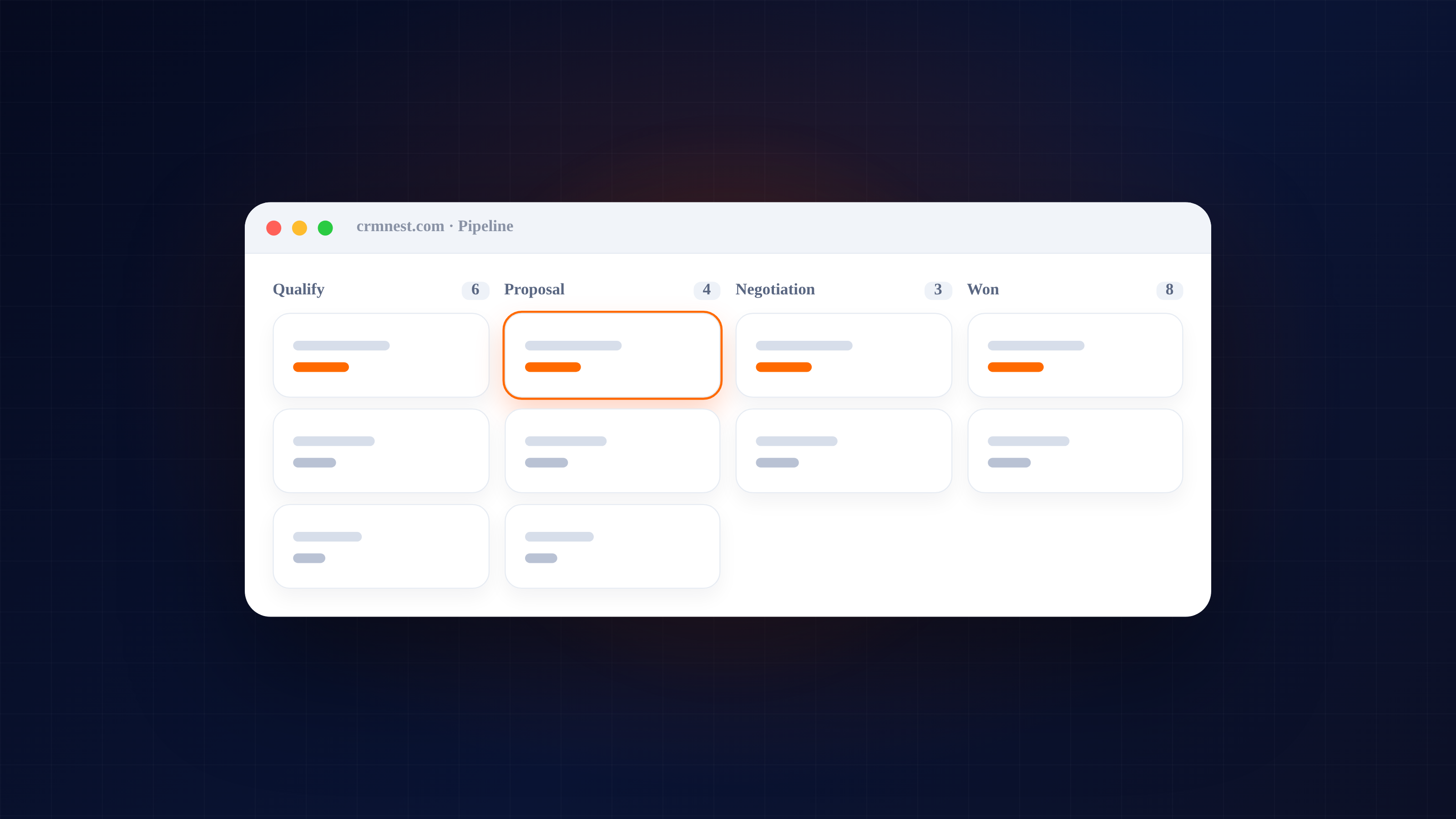
A sales pipeline is a visual representation of where every deal stands on its way from first contact to close, organised into stages. It works by moving each opportunity through those stages — so you can see what's open, what's stuck, and where your revenue will come from.
Key takeaways
- A sales pipeline is a visual map of open deals grouped into stages.
- Typical stages run from qualification through proposal and negotiation to close.
- The pipeline is what exists; the forecast is what you expect to close.
- Value per stage shows where the month's revenue actually lives.
If you've ever asked "how's the month looking?" and got a shrug in reply, you've felt the exact absence a sales pipeline fills. A pipeline turns that shrug into a board anyone on the team can read in ten seconds. It's the single most useful view in any CRM — and also the most misunderstood. Let's fix that.
1What a sales pipeline actually is
A sales pipeline is a visual map of your open deals, grouped into the stages they pass through on the way to a sale. Picture a board: each deal is a card, each stage is a column. At a glance you can see how many deals sit at each stage and how much they're collectively worth. It's your revenue, laid out as a series of steps instead of a mystery.
The power isn't the prettiness — it's the shared language. When "proposal" means the same thing to every rep and every manager, you can finally have precise conversations about real deals instead of vague ones about vibes.
2The typical stages (and what each one really means)
Stages vary by business, but a common, sensible structure looks like this:
- Qualification — is this a real, fit opportunity worth your time? If not, it shouldn't clutter the board.
- Needs analysis — you understand what the customer actually needs, not just what they first asked for.
- Proposal — you've put a concrete offer in front of them.
- Negotiation — you're working out terms, price, timing.
- Closed won / lost — the outcome, recorded either way (losing data is as valuable as winning data).
Good CRM software lets you tailor these to how your business genuinely sells, rather than forcing you into someone else's process.
3Pipeline vs forecast — they are not the same thing
This trips up a lot of teams. The pipeline is what exists — every open deal and the stage it's in. A forecast is what you expect to actually close, usually by weighting deals by stage or probability. The pipeline is the raw material; the forecast is the prediction you build from it. A clean pipeline makes the forecast trustworthy; a messy one makes it fiction.
Why value-per-stage matters: it tells you where the month's revenue actually lives — and whether you have enough early-stage deals to hit next month's number too. A pipeline that's all late-stage deals is a cliff, not a trend.
4How a pipeline works day to day
In practice, running a pipeline is a handful of small habits:
- As a deal progresses, you move its card to the next stage — so the board is always current.
- You attach the next action (a call-back or task) to every deal, so nothing stalls silently.
- Managers watch the whole board; reps work their own deals, scoped to their book.
- When a deal is won, it converts to a customer; when it's lost, you record why — which is gold for improving.
5The silent killer: stale deals
The enemy of every pipeline is the stale deal — the one sitting in a stage for weeks with no activity, slowly dying while everyone assumes someone else is on it. The fix is visibility plus scheduled follow-ups: make it obvious which deals have gone quiet, and attach a next step to every one so they keep moving. That's exactly what sales pipeline management in CRMNest is built to do.
6Three pipeline metrics worth watching
- Stage conversion rates — what percentage of deals move from one stage to the next? Low conversion at a specific stage shows you exactly where deals get stuck.
- Average time in stage — deals that linger too long are your early warning system.
- Pipeline coverage — is there enough total value in the pipeline to hit your target, given your win rate? If not, you have a prospecting problem, not a closing one.
You don't need to obsess over these on day one. But a pipeline that captures them turns your gut feel into numbers you can act on — and that's the whole point.
Frequently asked questions
What are the typical sales pipeline stages?
A common structure is Qualification, Needs Analysis, Proposal, Negotiation and Closed Won/Lost — tailored to how your business sells.
What's the difference between a pipeline and a forecast?
The pipeline is every open deal and its stage; the forecast is what you expect to close, usually by weighting deals by stage or probability.
How do you stop deals going stale?
Attach a next action to every deal and make stuck deals visible, so managers can nudge them before they die.